
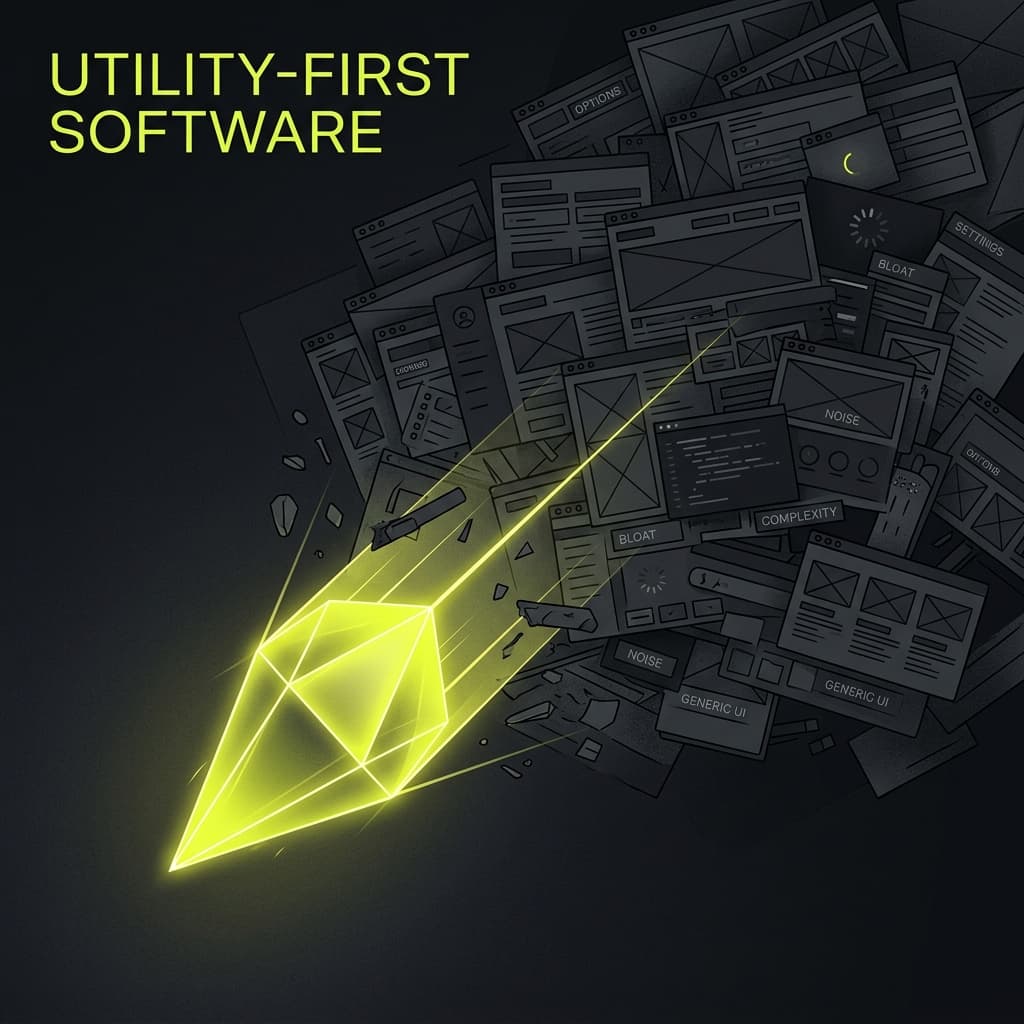
There's a tool I used every day for two years.
It did invoicing, project management, time tracking, client portals, proposals, contracts, team collaboration, and — I swear this is real — had a built-in CRM with pipeline management.
It also had a learning curve that took me three weeks to climb. A settings panel with 140 options. A help centre with over 800 articles. And a feature I discovered by accident six months in that would have saved me four hours a week if I'd found it on day one.
I never did figure out how to use the invoicing properly. I switched back to a spreadsheet.
That tool wasn't bad software. It was — by many measures — excellent software. It won awards. It had glowing reviews. Thousands of people used it daily and loved it.
But it wasn't built for me. It was built for everyone. And software built for everyone solves problems for no one particularly well.
“Software built for everyone solves problems for no one particularly well.”
That's the problem utility-first software exists to fix.
The feature trap
Here's how software usually gets built.
A team ships version 1.0. It does one thing. Users love it. Then the feedback starts rolling in: “Can it also do X?” “What about Y?” “We'd pay more if it had Z.”
The team adds X. Then Y. Then Z. Then seventeen more things because the roadmap is public and every user with a loud voice becomes a product manager.
Six months later, the thing that made version 1.0 great — its sharpness, its focus, its speed — has been buried under a navigation menu with eight sections and a toolbar that requires a tooltip to explain.
This is the feature trap. And almost every successful piece of software falls into it eventually, because the incentives all point one way: more features means more users means more revenue means more investment. The trap is built into the business model.
The users who needed the simple thing quietly move on. The users who wanted everything else are now dependent on a product that does everything tolerably well and nothing exceptionally.
What utility-first actually means
Utility-first software starts with a different question.
Not “what else can we add?” but “what's the one thing this needs to do, and can we do it perfectly?”
It's a philosophy borrowed, loosely, from the Unix tradition: write programs that do one thing and do it well. Write programs that work together. The original Unix tools — grep, sed, awk, cat — are each barely more than a single idea expressed in code. But combine them, and you can do almost anything.
Utility-first is that principle applied to the software people actually use every day.
A utility-first tool has a clear, specific problem it was built to solve. You can explain what it does in one sentence. You can use it without reading the documentation. And when you finish using it, you feel like the problem has been handled — not managed, not partially addressed, not “good enough for now.” Handled.
That's the solved state. That's what utility-first software delivers.
The difference in practice
Let me make this concrete.
Say you need to track which clients have reviewed which deliverables, and whether they've approved them. Simple problem. Happens in every creative and consulting business on earth.
The non-utility approach: buy a project management tool. Spend a week setting it up. Create a custom workflow with statuses and automations and Slack notifications. Train your team. Update three different views to keep them in sync. Realise six months later that nobody uses the statuses properly and you're back to checking in manually.
The utility-first approach: build or buy a tool that does exactly that — tracks deliverable review status per client. One screen. One job. Every morning you open it, you know where everything stands in ten seconds.
Same problem. Same goal. Completely different experience.
The first approach optimises for the tool's flexibility. The second optimises for your outcome.
Why most companies don't build this way
Honest answer: it's hard to charge for simplicity.
If you build something that does one thing perfectly, it's very easy for a competitor to undercut you. You can't hide behind complexity. You can't justify a price increase with a feature that most users will never touch. You can't raise a Series A on the story of “we do one thing really well.”
Utility-first software requires a different business logic: build trust instead of dependency. Charge fairly for the value delivered, not for the size of the feature list. Grow by solving more problems with more focused tools, not by making one tool do everything.
That's harder. It requires discipline. It requires saying no to good ideas because they don't belong in this particular tool.
But for the person using the software, it's transformative.
What it means for you
If you've ever opened a tool and felt immediately exhausted, that's the opposite of utility-first. If you've ever thought “I only use 10% of this thing,” that's the feature trap at work. If you've ever gone back to a spreadsheet because it was simpler — that's the market failing you.
You deserve software that respects your time. That assumes you're smart enough to know what you need without being upsold on what you don't. That was built to move you from problem to solved state with as little friction as possible.
That's what we build at Worqship.
Every tool we ship starts with one question: does this actually fix something? If the answer is an immediate yes, we build it. If we have to talk ourselves into it, we don't. No tool ships from this workshop without a one-sentence description that any person off the street could understand. No feature gets added unless it serves the core job better.
The bottom line
Utility-first software won't replace every tool you use. Some problems are genuinely complex and require complex solutions. That's fine.
But most software problems people face aren't complex. They're just unsolved — or solved badly by tools that were trying to do too many things at once.
The next time you find yourself three tabs deep into a settings panel, wondering why this is so complicated — ask yourself what the one thing is that you actually need done.
Then find the sharpest tool for exactly that job.
The workshop is open.
Frustrated by tools that do everything except the one thing you need? Tell us your problem