
Cloud & DevOps
Built to launch. Ready to keep running.
Cloud architecture, deployment pipelines, observability, and migrations that give your product a dependable operational foundation.
Signs your infrastructure needs real DevOps engineering
Common triggers for this engagement:
- Deployments are manual, undocumented, or dependent on one specific person knowing the steps.
- You've experienced downtime during deployments or traffic spikes that infrastructure should have handled.
- Your cloud bill is climbing without a clear picture of what's driving the cost.
- You're migrating from on-premise or a different cloud provider and need it done without service disruption.
A release needs a way forward and a way back.
Build checks, deployment environments, recovery, and observability belong in the same operating plan.
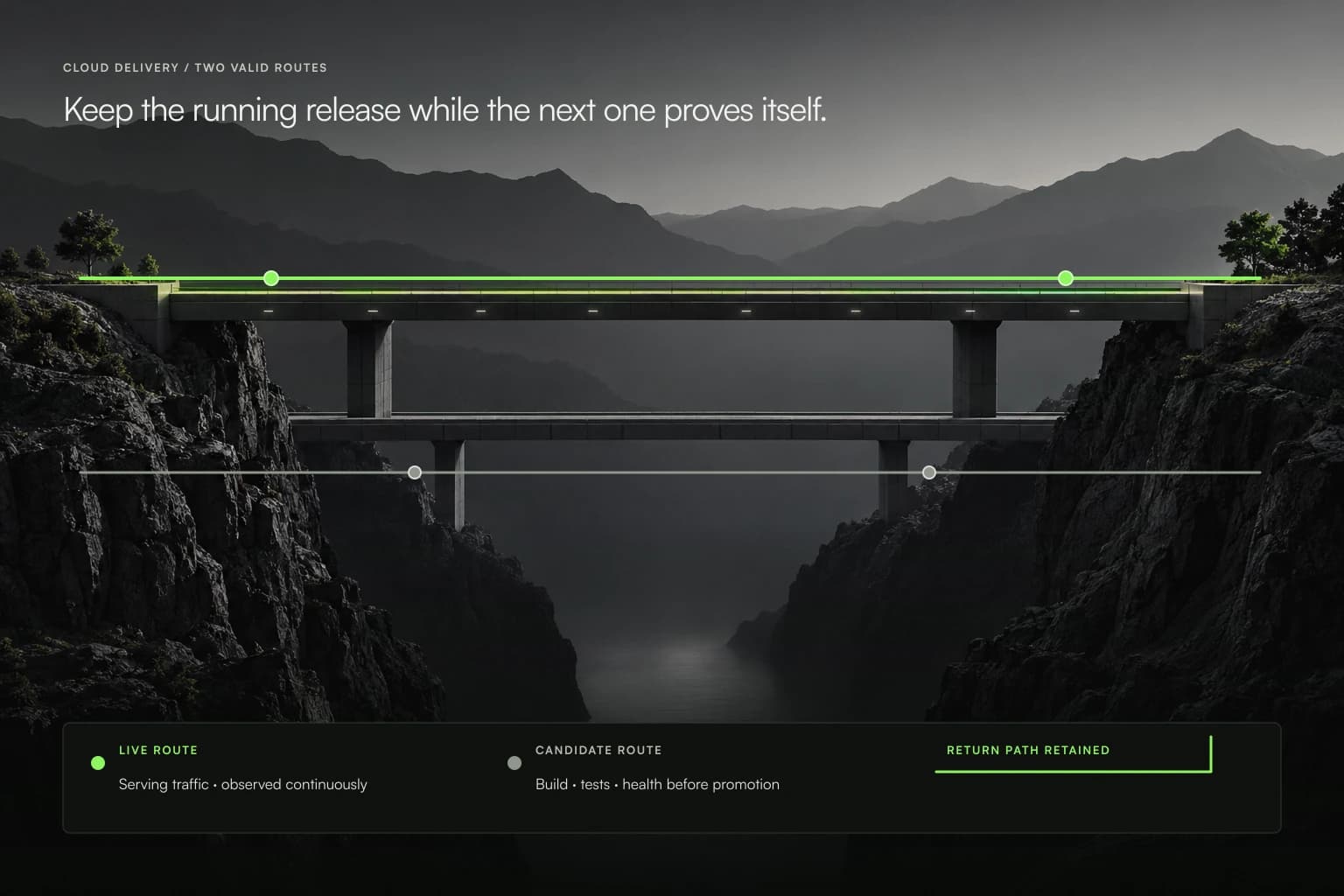
A release with a way back
- Keep the live release
Continue serving traffic through the running version while you observe its health.
- Check the candidate
Build, test, and verify the next version before moving traffic to it.
- Retain a recovery route
Keep a tested way back if errors or key user journeys deteriorate.
Tangible work. Clear deliverables.
Infrastructure architecture design
A cloud architecture designed for your actual traffic patterns, reliability needs, and budget — not over- or under-provisioned by default.
Infrastructure as code
Your environment defined in Terraform, so it's version-controlled, reproducible, and recoverable rather than manually configured.
CI/CD pipeline setup
Automated build, test, and deployment pipelines enabling frequent, low-risk releases with rollback capability.
Containerization
Applications packaged with Docker for consistency across development, staging, and production environments.
Monitoring & handover
Monitoring and alerting configured, with full documentation and access transferred to your team.
How the work comes together.
Infrastructure audit
We assess your current setup, cost drivers, reliability gaps, and deployment process.
Architecture design
A target architecture is designed and reviewed with your team, covering scaling, redundancy, and cost.
Infrastructure as code build
Environments are codified in Terraform and containerized with Docker, tested in staging before production.
CI/CD pipeline implementation
Automated pipelines are built and tested with real deployments, including rollback procedures.
Migration & handover
Production migration is executed with a zero (or minimal) downtime plan, with full documentation handed over.
Tools chosen for your product.
Your requirements, existing systems, and future team shape our technical choices.
Cloud providers
AWS / GCP / Azure / Linode
Infrastructure as code
Terraform / CloudFormation / Bash
Containerization & orchestration
Docker / Kubernetes / Helm
CI/CD
GitHub Actions / GitLab CI / Jenkins
Monitoring & observability
Sentry / Prometheus / Grafana
Questions before the first conversation.
Can you migrate us to the cloud without downtime?
Zero-downtime migration is achievable for most architectures using techniques like parallel running and gradual traffic cutover, which we plan explicitly as part of the migration design. We'll be upfront if your specific system has constraints that make brief downtime unavoidable.
Which cloud provider should we use?
It depends on your existing tooling, team familiarity, pricing model fit, and specific service requirements. We'll give a direct recommendation during the audit rather than defaulting to one provider regardless of fit.
Will this reduce our cloud costs?
Often, yes — unoptimized infrastructure commonly has significant cost waste from oversized resources or inefficient architecture. Cost optimization is part of the architecture review, though the primary goal is reliability and scalability first.
Do we need Kubernetes?
Not always. Kubernetes adds real operational complexity and is genuinely necessary for some scale and orchestration needs, but overkill for others. We'll recommend it only when it's the right fit for your actual requirements.
What happens if something breaks after handover?
Full documentation is provided so your team can operate independently. If you'd like ongoing support, that's available as a separate, optional engagement.
Let’s make it work
Let’s work out what your product needs.
Bring the idea, the current product, or the challenge. We’ll help define the next step and the right delivery approach.
Start a projectClarity from the first conversation.
Start with your business problem
Agree the scope before the build
Own your code and infrastructure