
Webtunes
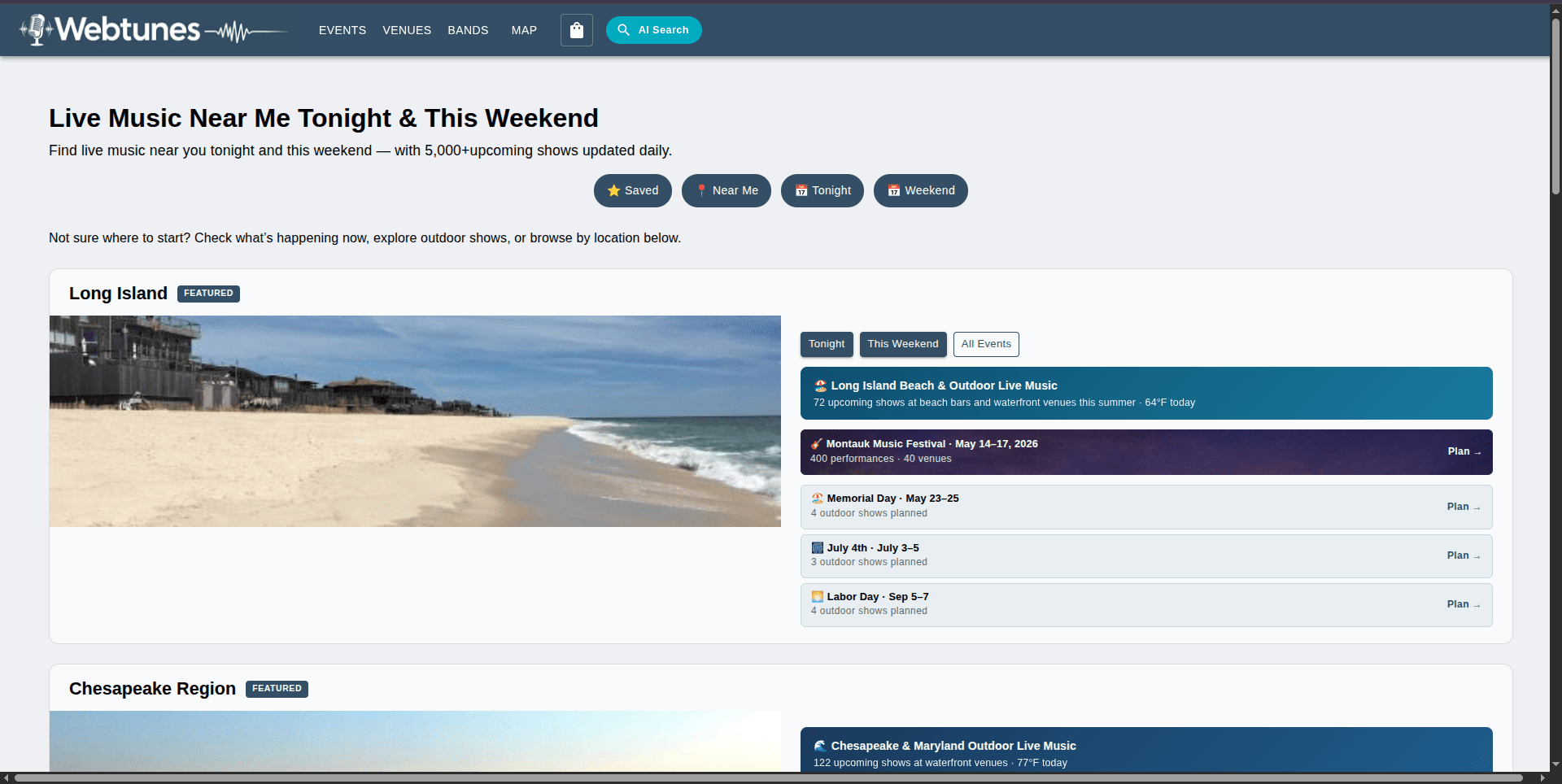
A live music discovery platform that brings concerts, bar shows, and festivals into a searchable experience.
Read the project storyAI systems
AI features, retrieval systems, document workflows, and predictive models designed with evaluation, permissions, and real product value in mind.
This service tends to make sense when:
Approved data, evaluation examples, and a route for uncertain outputs shape the feature before it reaches users.

Project captures and the decisions behind them.
A live music discovery platform that brings concerts, bar shows, and festivals into a searchable experience.
Read the project storyAn honest evaluation of whether ML is the right approach, what data is required, and what accuracy is realistically achievable.
Building the pipelines needed to collect, clean, and structure the data the model depends on.
Custom model training, or integration of proven pre-trained models, depending on what the problem actually requires.
The model is integrated into your actual workflow or application — not left running in a notebook nobody uses.
Ongoing accuracy monitoring so model performance degradation is caught early, not discovered after it's caused damage.
We define the specific decision or task to improve and assess whether the available data can realistically support it.
Building reliable pipelines to collect and prepare the data the model needs, often the most underestimated part of ML projects.
Building, training, and rigorously validating the model against real-world data, not just a clean test set.
Integrating the model into your existing application or workflow so it's actually used, not just demoed.
Setting up performance monitoring and handing over full documentation and code ownership.
Your requirements, existing systems, and future team shape our technical choices.
Python / PyTorch / TensorFlow / scikit-learn
Pandas / Apache Airflow / PostgreSQL / Elasticsearch
AWS SageMaker / Google Vertex AI / Docker / REST/gRPC model serving
Model performance tracking / Data drift detection
It depends heavily on the problem, but this is exactly what the feasibility assessment phase determines — we won't recommend a custom ML approach if your data volume or quality can't realistically support it.
Validation happens against real-world data before any production integration, so this is caught early. If accuracy targets genuinely can't be met, we'll tell you honestly rather than shipping something unreliable.
Whichever is appropriate. Many problems are well served by fine-tuning existing models, which is faster and cheaper than training from scratch — we only recommend custom training when it's genuinely necessary.
Yes. We cover retrieval and LLM-based features alongside forecasting, classification, and other machine learning applications. The task, available information, evaluation criteria, and operating cost determine the approach.
We set up monitoring for performance and data drift as part of the deliverable. Ongoing retraining or support can be scoped separately if needed.
Let’s make it work
Bring the idea, the current product, or the challenge. We’ll help define the next step and the right delivery approach.
Start a projectStart with your business problem
Agree the scope before the build
Own your code and infrastructure